

Does Strip Till Pay? Inside – PCT | Sunrise, Unverferth and Sunrise Precision Solutions Strip Till Research
Strip tillage isn’t new – but the questions surrounding it are as relevant as ever. Does strip till pay? Can it reduce input costs without sacrificing yield? What’s the right fertilizer rate, depth, and timing?
To help answer these questions, Sunrise Precision Solutions, PCT | Sunrise, and Unverferth Manufacturing have come together for an in‑depth strip till research project designed with one clear goal: returning value to farmer-owners.
A Research Project Built for Farmers
Doug Wical, Field Technology Lead with Sunrise Precision Solutions, and Bryan Reeb, Research Agronomist with PCT | Sunrise, explain that this project isn’t about launching a custom strip till service. Instead, it’s about delivering real‑world answers to the questions farmers are already asking.
As a farmer‑owned cooperative, Sunrise’s responsibility is to bring value back to its members. And with fertilizer prices continuing to climb, understanding where efficiencies can be gained has never been more important.
The core questions driving the research include:
- What products work best in strip till?
- What is the ideal timing for application?
- How deep should tillage and fertilizer placement be?
- Can fertilizer rates be reduced?
- Are there opportunities to add products that improve crop response?
- Ultimately – does strip till provide a financial or yield advantage?

Why Partner with Unverferth Manufacturing?
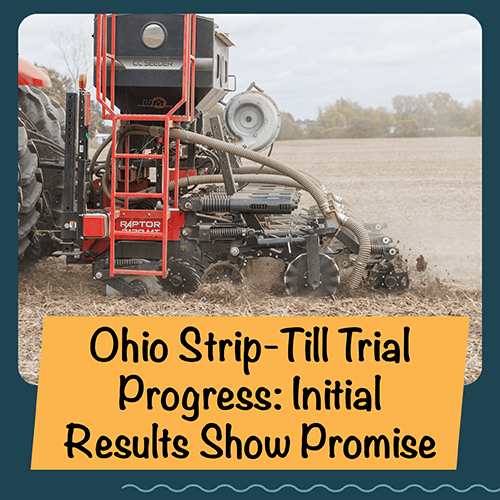
While many strip till tools exist on the market, the partnership with Unverferth Manufacturing allows Sunrise to study something unique: precision and flexibility in both tillage depth and fertilizer placement.
Using the Unverferth Raptor strip till bar, the research team can independently adjust:
- Tillage depth from 6 to 10 inches
- Fertilizer placement depth from 4 to 8 inches
This level of control allows researchers to evaluate how precise placement affects nutrient availability, root development, and overall crop performance – capabilities that many other strip till systems simply don’t provide.
For Unverferth, the collaboration isn’t just about the tool itself. It’s about understanding how equipment design supports agronomic goals related to timing, placement, and stewardship.
Stewardship and the 4Rs in Action
A major driver behind the project is environmental responsibility, particularly in alignment with Ohio watershed initiatives. The research emphasizes the 4R Nutrient Stewardship principles:
- Right source
- Right rate
- Right time
- Right place
Strip till offers a unique opportunity to apply nutrients where they’re most needed – within the row – while limiting surface applications that can increase runoff risk. This approach supports both agronomic performance and conservation goals, especially for growers in sensitive watersheds.
Integrating Precision Agriculture Technology 
Beyond the strip till bar itself, the project also showcases the broader suite of technologies supported by Sunrise Precision Solutions.
These include:
- Precision rate control
- Row‑by‑row monitoring
- Application verification to ensure each row receives the correct rate
- Tractor guidance systems and application controllers
Together, these tools help ensure accuracy, consistency, and confidence in every pass across the field.
Adding Value Through Products and Placement
From the PCT | Sunrise perspective, the research also explores what additional products can be placed in the strip to enhance crop performance.
In addition to meeting general crop fertility needs based on soil tests and crop removal, the project evaluates products designed to boost early growth and nutrient uptake, including:
- Micronutrient‑containing fertilizers
- Biologicals and biostimulants
- Humic acids and other soil health‑focused inputs
By placing these products directly in the row, the team is studying whether crops respond more efficiently compared to traditional broadcast applications.
Measuring Results Throughout the Season
The work doesn’t stop once the strip is made. Throughout the growing season, the research team will evaluate:
- Soil temperature differences
- Tissue testing results
- Root digs
- Nutrient response and crop development
These observations are critical to understanding not only if strip till works, but why it works – and under what conditions it delivers the most value.
What This Means for Growers
This collaborative strip till project is about more than equipment or inputs. It’s about giving growers the information they need to make confident, data‑driven decisions in a challenging economic environment.
By combining agronomic research, precision technology, and equipment innovation, Sunrise and its partners aim to answer the question farmers keep asking:
Does strip till pay – and how can we do it the right way?
As the season progresses, more results and insights will be shared. Stay tuned as the data comes in and the story continues to unfold.